
A single “OK text reply” can carry a hundred different meanings depending on who sent it, when, and why. Sometimes it’s warm agreement, sometimes it’s a dry text that ends the conversation, and sometimes it feels outright rude or dismissive. Learning how to respond to OK text the right way good-night-messages whether you want to keep things polite, funny, flirty, or savage — can completely change the tone of a conversation. This guide breaks down every situation, mood, and relationship type so you always know exactly what to say back.
How to Interpret ‘OK’ Text Meanings Before Responding
Before picking a reply, it helps to understand OK text meaning in context. The same two letters can be a simple confirmation, a passive-aggressive text, or a sign of disinterest — texting etiquette says tone almost always lives in the surrounding conversation, not the word itself.
When “OK” Means Agreement
This is the most common and harmless version amazon plain confirmation with no hidden emotion behind it.
- “Perfect, see you then!”
- “Awesome, thanks for confirming.”
- “Great, that works for me.”
- “Cool, I’ll get it sorted.”
- “Sounds good — appreciate the quick reply.”
- “Noted, thank you!”
- “That works, talk soon.”
- “Good to know, thanks.”
When “OK” Sounds Dry or Rude
A dry OK text usually shows up when someone’s mood has shifted mid-conversation.wikipedia Instead of matching the coldness, a calm, curious reply often works better.
- “That felt a little short — everything alright?”
- “Okay… did I say something wrong?”
- “Noted. You sound a bit off, want to talk about it?”
- “Alright then. I’ll leave it here for now.”
- “Got it. Let me know if something’s bothering you.”
- “Fair enough, I’ll check back later.”
When “OK” Signals Disinterest
When someone repeatedly sends one-word replies, it’s usually a sign of disinterest in texting rather than a bad day.
- “Seems like you’re busy — we can talk later.”
- “No worries, I’ll let you be.”
- “Alright, catch you when you’re free.”
- “Sounds like a one-word kind of day, I’ll step back.”
- “Okay, I’ll take the hint.”
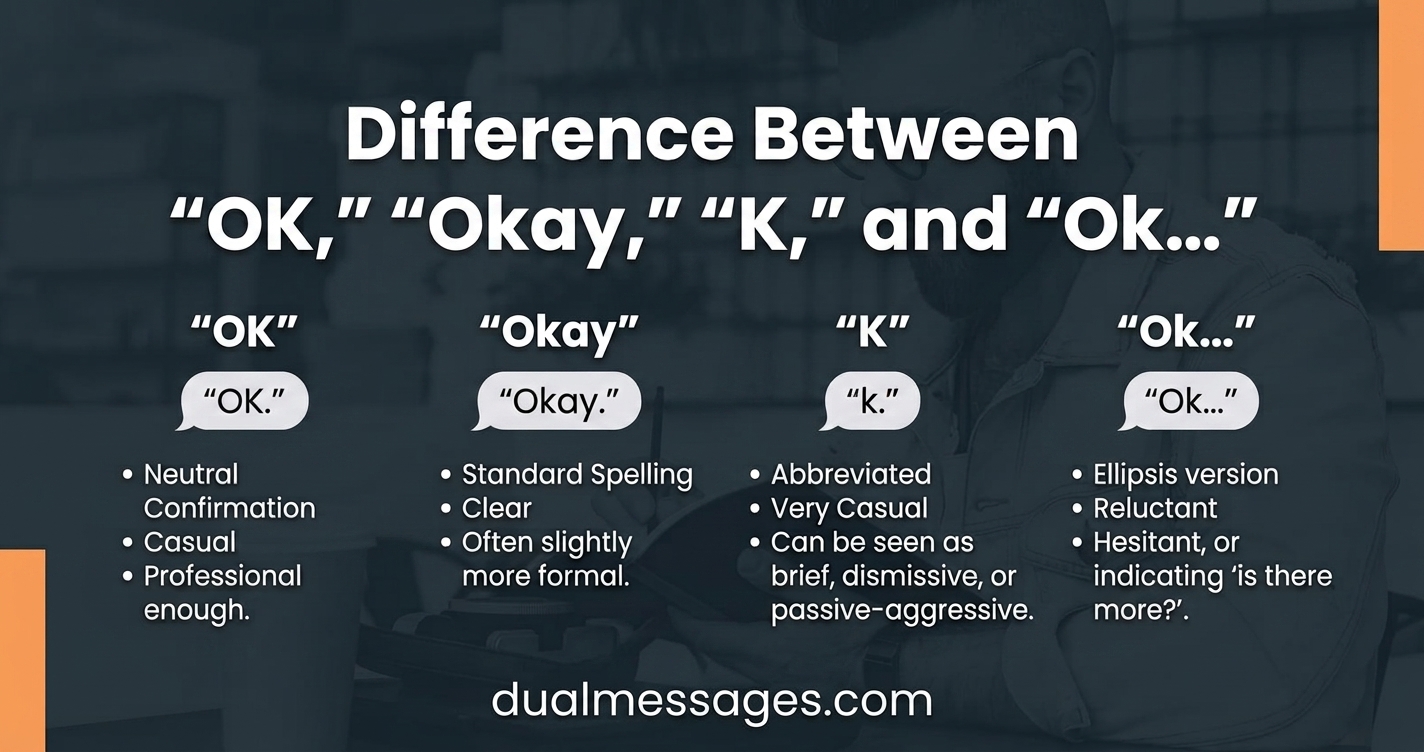
Difference Between “OK,” “Okay,” “K,” and “Ok…”
Each spelling shifts the tone completely:
- OK – neutral, casual, everyday confirmation.
- Okay – slightly warmer and more thought-out, often used in professional or caring conversations.
- K – short and blunt, frequently read as a dismissive text reply or mild irritation.
- Ok… – the trailing dots usually signal hesitation, sarcasm, or unspoken frustration — a classic passive-aggressive text.
Recognizing this small difference is the first step toward correct text tone interpretation before you even type a response.
Polite & Neutral Responses to “OK” Text
Simple Acknowledging Replies
- “Got it, thanks!”
- “Understood.”
- “Alright, appreciate you letting me know.”
- “Okay, noted with thanks.”
- “Perfect, thank you for confirming.”
Professional Responses to “OK” Text
For an OK text at work, Slack, or email, keep it clean and courteous:
- “Thanks for confirming — I’ll proceed accordingly.”
- “Understood, I’ll update the team.”
- “Noted, will follow up by end of day.”
- “Great, I’ll share the next steps shortly.”
- “Appreciate the quick response — moving forward now.”
Polite Ways to Keep the Conversation Going
- “Glad that works! By the way, how’s your week going?”
- “Awesome — did you get a chance to see the message I sent earlier?”
- “Great, thanks. Also, I came across a quote today that reminded me of our chat.”
- “Perfect. Anything exciting planned for the weekend?”
- “Sounds good — let’s pick this up again soon.”
Funny Replies to “OK” Text
Playful Responses to “OK”
- “OK as in ‘okay okay’ or OK as in ‘please stop talking’?”
- “Wow, such enthusiasm, I’m overwhelmed.”
- “That ‘OK’ had more plot twists than a movie.”
- “I felt that energy through the screen.”
- “OK noted, filing this under ‘thrilling replies.'”
Sarcastic but Friendly Replies
- “Careful, all that excitement might break the phone.”
- “I’ll cherish this deeply emotional response forever.”
- “Wow, save some enthusiasm for the rest of us.”
- “That’s the most action-packed ‘OK’ I’ve seen all week.”
Meme-Style or Emoji Responses
- “OK 👍 (said in the flattest voice possible)”
- “💀 that reply killed the conversation”
- “OK but make it dramatic 🎭”
- “🥲 noted, I guess”
- “OK king/queen 👑”
Flirty Responses to “OK” Text
Cute & Playful Flirty Replies
- “Just OK? I was hoping for a little more excitement 😏”
- “OK is cute, but you’re cuter.”
- “Careful, that short reply is making me curious about you.”
- “Is that an OK or are you just playing hard to get?”
Teasing Responses That Spark Conversation
- “Hmm, one word — someone’s playing it cool today.”
- “I see what you’re doing, and I like it.”
- “OK for now, but I expect more later 😉”
- “That’s not enough words for someone this interesting.”
When “OK” Feels Emotionally Distant
- “That felt a bit distant — did I say something wrong?”
- “Short reply, thoughtful mind — what’s going on in there?”
- “OK… I sense there’s more you’re not saying.”
- “You okay? That didn’t feel like your usual self.”
Savage & Sassy Replies to “OK” Text
Confident Clapbacks
- “Noted. I’ll match your effort from now on.”
- “Cool, I’ll remember this energy.”
- “Received loud and clear.”
- “OK works both ways, apparently.”
Dry Responses to Match Their Energy
- “K.”
- “Sure.”
- “Noted.”
- “Alright then.”
When You’re Done Carrying the Conversation
- “Guess I’ll stop typing paragraphs then.”
- “Noted, I’ll keep future replies just as short.”
- “Alright, message received.”
- “That’s fine, I’ll let the conversation rest.”
Short & One-Word Responses to “OK”
One-Word Replies
- “Cool.”
- “Alright.”
- “Sure.”
- “Noted.”
- “Fine.”
Emoji-Only Responses
| Emoji | Tone / Meaning | Best Used For |
| 👍 | Neutral / Quick | Safe and simple confirmation |
| 😊 | Warm & Friendly | Polite or appreciative replies |
| 🙃 | Sarcastic / Playful | Light teasing or playful drama |
| 👌 | Clear & Direct | Formal or clear agreement |
| 😐 | Dry / Unamused | Subtle disappointment or cold response |
When Less Is More
Sometimes matching energy with a short, calm one word response to OK is smarter than overexplaining — especially in casual or fading conversations.
How to Respond When “OK” Feels Rude or Dismissive
Signs the “OK” Is Negative
- No punctuation plus a long delay before replying.
- Capital letters like “OK.” with a period, which often reads as a dismissive text.
- A sudden shift from long messages to one word.
Calm Responses That Ask for Clarity
- “That felt a little short — is everything okay?”
- “Did something upset you?”
- “I want to understand — are you annoyed with me?”
- “Let me know if I did something wrong.”
Setting Boundaries Without Escalation
- “If something’s bothering you, I’d rather talk about it directly.”
- “I’m happy to continue this conversation when you’re ready.”
- “Let’s talk properly instead of one-word replies.”
How to Respond to “OK?” (Asking for Permission or Approval)
Positive Responses to “OK?”
- “Yes, that works perfectly.”
- “Absolutely, go ahead.”
- “Sure, sounds good to me.”
- “Yes, no issues at all.”
Neutral or Delayed Responses
- “Let me check and confirm shortly.”
- “I’ll get back to you on that.”
- “Give me a moment to think it over.”
Negative or Boundary-Setting Responses
- “Actually, that doesn’t work for me.”
- “I’d prefer a different approach.”
- “Not quite — can we adjust it a bit?”
What to Reply When You Don’t Know What “OK” Means
Clarifying Without Sounding Needy
- “Just want to make sure — are we good?”
- “Quick check, does that OK mean you’re fine with it?”
- “Want to confirm we’re on the same page.”
Playful Clarification Replies
- “Is that an ‘OK OK’ or an ‘OK, moving on’ kind of OK?”
- “I need a translator for that OK 😂”
- “That OK had layers, explain please.”
Direct but Respectful Follow-Ups
- “Can you tell me what you mean by that?”
- “I want to understand your tone better here.”
- “Mind clarifying so I don’t misread it?”
Should You Reply to an “OK” Text at All?
When Replying Helps
Replying helps when the relationship matters, when clarity is needed, or when silence could be misread as ignoring a text on purpose.
When Ignoring Is Better
If the “OK” is clearly the end of a one-sided or draining exchange, sometimes the smartest response is no response at all — quietly matching text energy instead of chasing the conversation.
Matching Energy vs. Leading the Conversation
Deciding between matching text energy and continuing to lead the conversation depends on how much you value keeping the exchange going versus protecting your own effort.
Final Thoughts — Context Matters More Than the Word “OK”
At the end of the day, no single word carries a fixed meaning — context, timing, and history between two people shape everything. Whether “OK” is agreement, a dry text, or a subtle sign of disinterest in texting, the right response comes from reading the full conversation rather than reacting to two letters alone. Sometimes the best follow-up isn’t even a clever reply — it could be a warm line of wishes, a shared quote that fits the mood, or simply a direct, honest question that clears the air.
Conclusion
Texting is full of small words that carry big meaning, and “OK” is one of the trickiest of them all. As this guide shows, the right reply depends entirely on tone, timing, and the relationship between the two people texting — the same word can mean agreement, distance, sarcasm, or even affection. Whether you choose a polite response to OK text, a funny one-liner, a flirty tease, or a calm boundary-setting message, the goal is always the same: reply in a way that matches your intention, not just the word on the screen. And sometimes, the warmest way forward isn’t a clever comeback at all — it’s a genuine wish, a fitting quote, or an honest question that turns a flat “OK” into a real conversation again.
FAQs About Responding to “OK” Text
What to reply when someone says it’s okay?
A simple “Thank you for understanding” or “Appreciate that” works well for confirmation vs disagreement text situations — it acknowledges their okay without overexplaining.
Is OK a dry text?
It can be. Without punctuation, emojis, or follow-up, “OK” often reads as a dry text, especially compared to “Okay!” or “Sounds good!”
How to respond to “hey you ok”?
Answer honestly and briefly: “Yeah, just a busy day, thanks for checking in” or “Not really, can we talk?” — both keep the door open for a real conversation.
What’s a better response than OK?
Try “Sounds good,” “Got it, thanks,” or “Perfect, see you then” — small additions instantly improve texting etiquette and warmth compared to a bare “OK.”